
Russia’s War
Order here
Polity, 17 March 2023
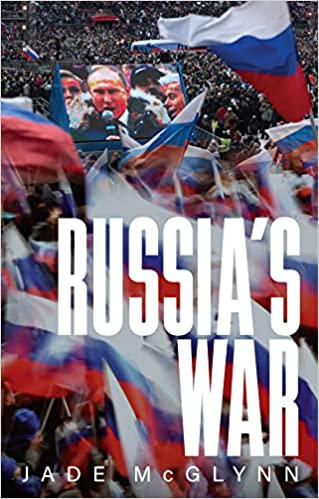
In the early hours of 24th February 2022, Russian forces attacked Ukraine. The brutality of the Russian assault has horrified the world. But Russians themselves appear to be watching an entirely different war – one in which they are the courageous underdogs and kind-hearted heroes successfully battling a malign Ukrainian foe.
Russia analyst Jade McGlynn takes us on a journey into this parallel military and political universe to reveal the sometimes monstrous, sometimes misconstrued attitudes behind Russian majority backing for the invasion. Drawing on media analysis and interviews with ordinary citizens, officials and foreign policy elites in Russia and Ukraine, McGlynn explores the grievances, lies and half-truths that pervade the Russian worldview. She also exposes the complicity of many Russians, who have invested too deeply in the Kremlin’s alternative narratives to regard the war as Putin’s foolhardy mission. In their eyes, this is Russia’s war – against Ukraine, against the West, against evil – and there can be no turning back
A New Statesman Book of the Year 2023
Shortlisted for the Pushkin House Prize 2023. Special Commendation.
“This is the most comprehensive analysis of popular support for Russia’s war to date. Jade McGlynn emphasizes that broad swathes of Russian society back the invasion and unpacks the varied reasons for this support. An important read for anyone interested in Russia’s invasion of Ukraine.”
Timothy M. Frye, author of Weak Strongman: The Limits of Power in Putin’s Russia
“Timely, original and highly readable, McGlynn’s book is essential for anyone wishing to understand the past, present and future difficulties we face in dealing with Russia.”
Edward Lucas, former Economist Moscow correspondent and author of The New Cold War
“McGlynn offers a tantalising glimpse into the Russian public’s perception of the war in Ukraine. Do the Russians care? McGlynn provides the answer in a gripping narrative that brings out the nationalist fervour, the cautious scepticism and the mind-boggling indifference of those on whom Vladimir Putin counts for support.”
Sergey Radchenko, Johns Hopkins University
“An unnerving exposé of Russian support for the war against Ukraine.”
James Ryan, Cardiff University
“An invigorating take on Russia’s war in Ukraine. McGlynn’s refreshing analysis looks beyond the battlefield to understand how Russians see the conflict.”
Rasmus Nilsson, University College London
“compelling”
The Moscow Times
“Superb. A must-read for anyone looking for an understanding of Russian attitudes.”
Richard Shirreff, Co-Founder and Managing Partner of Strategia Worldwide and former NATO Deputy Supreme Allied Commander Europe
“Anyone who wants to understand why so many Russians support the war in Ukraine should start here”
Simon Baugh, Chief Executive of UK Government Communications
“The most extensive examination so far of Russian attitudes to the invasion and the nefarious methods that the Kremlin uses to try to manipulate minds … Russia’s War is a thoughtful guide to this deadly cocktail of confusion and hatred. Just don’t expect any easy answers.”
The Times
“Russian support for the war identified by McGlynn represents a major obstacle to the building of bridges, so her argument that we need to understand it is hard to deny.”
Financial Times
“Urgently relevant, highly readable.”
Owen Matthews, Times Literary Supplement
“Powerful and disturbing”
The Washington Post
“A journey into the heart of darkness, even madness, but with a cool-headed and astute guide we quickly learn to trust.”
Robin Ashenden, The Spectator
“Anybody wishing to better understand why Russians continue to support this murderous conflict will learn much from this pithy and insightful study”
Robert Dale, CEU Review of Books
Memory Makers: The Politics of the Past in Putin’s Russia
Bloomsbury, June 2023
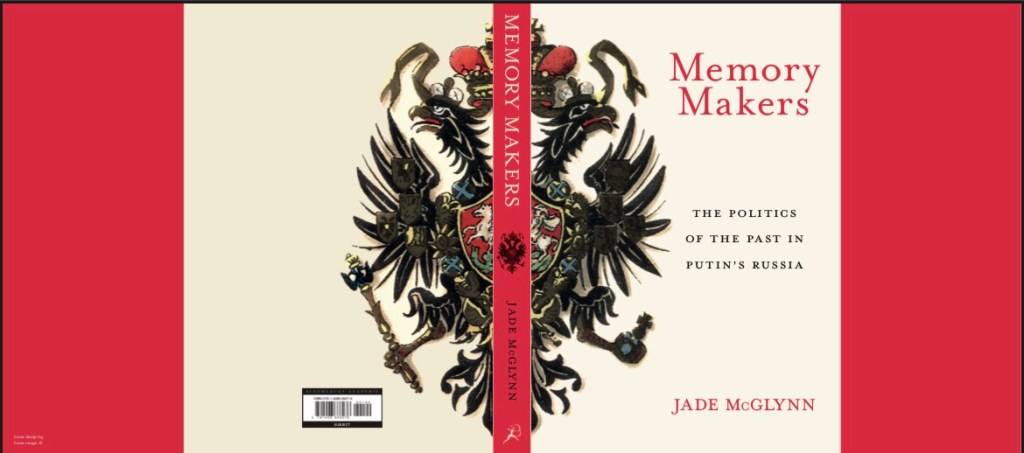
Why aren’t ordinary Russians more outraged by Putin’s invasion of Ukraine? Inside the Kremlin’s own historical propaganda narratives, Russia’s invasion of Ukraine makes complete sense. From its World War II cult to anti-Western conspiracy theories, the Kremlin has long used myth and memory to legitimize repression at home and imperialism abroad, its patriotic history resonating with and persuading large swathes of the Russian population.
In Memory Makers, Russia analyst Jade McGlynn takes us into the depths of Russian historical propaganda, revealing the chilling web of nationwide narratives and practices perforating everyday life, from after-school patriotic history clubs to tower block World War II murals. The use of history to manifest a particular Russian identity has had grotesque, even gruesome, consequences, but it belongs to a global political pattern – where one’s view of history is the ultimate marker of political loyalty, patriotism and national belonging. Memory Makers demonstrates how the extreme Russian experience is a stark warning to other nations tempted to stare too long at the reflection of their own imagined and heroic past.
“With authority and skill…McGlynn gives what now ranks as the most reliable up-to-date account of the use and misuse of history and memory in post-Soviet Russia”
Tony Barber, Financial Times
“Scholarly, revelatory, and deeply unsettling”
Allan Mallinson, Country Life
“McGlynn’s informative study of Russia’s memory wars shows just how easily performance, media narratives, and cultural priming can slip into real violence”
Times Literary Supplement
“McGlynn presents a powerful and distrubing case….her insightful and creative analysis suggests that we are in for a long conflict not just over the fate of Ukraine, but also over how differing memories of the past will continue to shape the future”
Washington Post
“History is back – armed with artillery and with a commitment to genocide. Jade McGlynn’s highly timely study shows how Putin weaponises the past to destroy the future”
Peter Pomerantsev
“McGlynn’s fascinating study shows how Russian memory politics does much more than evoke memories of World War Two. Its particular propaganda form is to replay and conflate the past and the present. Events in Ukraine in 2014 are not just said to echo those of the 1940s, footage and commentary are literately spliced together; Russia’s intervention in Syria is depicted as the Cold War that wasn’t, with Moscow victorious.” ―Andrew Wilson, University College London, author of ‘Ukraine Crisis: What it Means for the West’
Professor Andrew WIlson, UCL
Researching Memory and Identity in Russia and Eastern Europe – Interdisciplinary Methodologies
Jade McGlynn, Oliver Jones, Palgrave Macmillan, 2022

This book offers a collection of innovative methodological approaches to Memory Studies in Russia and Eastern Europe. Providing insights into the relationship between memory and identity, the twelve chapters provide multidisciplinary analysis of how history is used to reinforce, remould, and reinvent national and group identities.
This analysis includes a strong emphasis on interrogating the role of the researcher and the impact of methodology, exploring the field’s most pressing challenges, such as the subjectivity of remembrance, reception versus production of discourse, and the inclusion of marginal perspectives.
By focussing on countries in which the past is highly politicised, including Serbia, Ukraine, Poland, Russia and the Baltic States, the volume also analyses the diverse – and often conflicting – ways in which historical narratives emerge from these states’ efforts to create new pasts that shape their respective visions of the future, with pressing ramifications across this region and beyond.
Rethinking Period Boundaries: New Approaches to Continuity and Discontinuity in Modern European History and Culture
Lucian George, Jade McGlynn, De Gruyter, 2022
Buy at Waterstones or Amazon
Periodisation is an ever-present feature of the grammar of history-writing. As with all grammatical rules, the order it imposes can both liberate and stifle. Though few historians would consider their period boundaries as anything more than useful guidelines, heuristic artifice all too easily congeals into immovable structure, blinkering the historical gaze. Researchers of literature are, of course, challenged by similar dilemmas. Here, too, the neatness of periodisation can obscure the cultural output of awkward individuals that do not fit the right chronological corset, whilst also creating unfounded expectations of shared experience and expression. Rather than discard periodisation altogether, in this cross-disciplinary volume an international group of historians and literary scholars presents different ways in which accepted period boundaries in modern European history can be challenged and rethought. To do so, they explore unnoticed continuities, and instances of delayed cultural transfer that defy easy periodisation; adopt the perspective of social groups that standard periodisation schemes have ignored; and consider how historical actors themselves divide up history and how this can affect their actions.
 Jade McGlynn